
Connecticut Fishing Line Recycling Locations
Help protect wildlife
 Carelessly discarded fishing line can seriously harm or kill wildlife. Animals can become entangled in, or ingest, the line, which can cause starvation, strangulation, and deep wounding. Wildlife usually cannot survive the injuries they sustain from entanglements.
 To prevent incidents like the dead osprey (pictured left) found in Old Lyme, the DEEP, along with the Menunkatuck Audubon Societyand Connecticut Audubon Society, has installed monofilament fishing line recycling receptacles at inland and coastal sites around the state to encourage less waste line in the environment. The disposed fishing line is collected by volunteers and then sent to a company that recycles it to make underwater habitat structures for fish. Presently, 35 receptacles are set up in Connecticut, spanning throughout 21 towns. Make a difference for wildlife by properly disposing of fishing line, hooks, lures, weights, and all other trash.
Find the recycling receptacle nearest you
Select the link for your town of interest, and you will be directed to a map with the address of receptacles within that town.
- Avon
- Branford
- Bridgeport
- Fairfield (Multiple Locations)
- Farmington
- Groton
- Guilford
- Hamden
- Madison
- Meriden
- Milford
- New Fairfield
- New Haven (Multiple locations)
- Old Lyme
- Salem
- Salisbury
- Stonington
- Stratford
- Torrington
- West Haven
- Winchester
Start a volunteer recycling program in your town
As of 2019, 19 fishing line recycling receptacles have been installed at local docks and piers in Fairfield and Bridgeport by five high school students from Fairfield. DEEP will collect the discarded line from a site monitor who will periodically empty their assigned receptacle. The Connecticut Audubon Society was the lead sponsor of the project.
As of 2025, 9 fishing line recycling receptacles have been installed at various waterbodies in the City of Meriden by the local youth group, Ball Headz, in coordination with the Meriden Conservation Commission. The receptacles were constructed by students at Lyman Hall High School in Wallingford.
If there is not a convenient location in your community to recycle fishing line, consider starting your own recycling program at your favorite fishing site. Start by talking to your local marina, tackle shop, or fishing supply store to see if they would be interested in starting a recycling program. The BoatU.S. Foundation provides plans for building your own fishing line recycling receptacles. The Berkley Conservation Institute makes it easy for retailers, groups, and individuals to create their own recycling collection programs for fishing line. To participate as a retailer, you can request a recycling collection bin and it will be shipped at no charge. As individuals, you can mail it directly to Berkley.
Help protect wildlife and keep your favorite fishing area clean by placing waste fishing line in a recycling receptacle. It is the responsible thing to do!
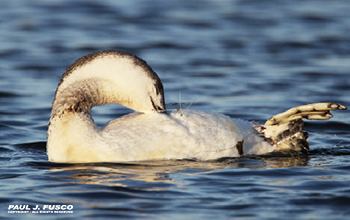
Fishing line, hooks, lures, sinkers, kite string, helium balloons, plastic bags, and other carelessly discarded trash are deadly to wildlife. This red-throated loon was found in Guilford with fishing tackle entangled around its body. Unfortunately, the loon could not be caught to remove the fishing line, and its fate remains unknown.
Please retrieve these items and discard them in covered trash or recycling containers. We all can help further by picking up other people's trash, especially along our waterways.
The Monofilament Fishing Line Recycling Project received funding from Connecticut's Endangered Species/Wildlife Income Tax Check-off Fund.
Content last updated on September 21, 2026.