

Deterring Bears with Electric Fencing
Any bear may take advantage of an easily accessible food source, whether it is a bird feeder, beehive, crop, feed, or unprotected chickens, goats, or other livestock. The best approach to managing these conflicts is preventing bears from accessing these resources in the first place.
Electric fencing is a safe, highly effective tool used throughout the world to exclude bears and protect valuable resources.
Do not wait until damage occurs to think about protection. If you keep livestock, maintain beehives, grow crops, or have another resource that is important to you, consider bear protection when initially planning the enclosure or operation.
Electric fencing is a safe, highly effective, and cost-effective way to exclude bears and other wildlife. A properly designed bear fence can often be installed in just a few hours for less than $500, provide protection for years with routine maintenance, and remain on guard 24 hours a day—even when no one is there to monitor animals or property.
The time and money invested in prevention can be far less than the cost of even one successful bear visit, resulting in lost livestock, damaged crops or apiaries, or property damage.
Below is a collection of resources for those looking for additional information on electric fencing.
- Electric Fence Tips for Bears - DEEP Wildlife Division rack card.
- Electric Fences Keep Bears Out - A BearWise Bulletin - BearWise.
- Raising Chickens in Bear Country - BearWise Bulletin on how to protect chickens from bears.
- Keep Bears Out: Livestock, Bees, Crops, Orchards - Tips from BearWise
- Keep Chickens Safe Poster
- Deterring Bears with Electrified Fencing - a beginner's guide - Publication by Montana Fish, Wildlife, and Parks
- Preventing Wildlife Conflicts with Electric Fencing - DEEP Wildlife Division video
- Deterring Bears with Electric Unwelcome Mats
Electric Fence Workshops
 Recently, the DEEP Wildlife Division began offering free workshops that focus on proper electric fence installation, including tips on how to successfully deter bears and other wildlife from damaging apiaries and chicken coops. These workshops are a great place to start for those not only considering the use of electric fencing, but also for those who have experienced difficulty with their setup. Registration is required to attend.
2026 offerings:
- Sunday, April 19, from 9:30 a.m. to 12:00 p.m., at Sessions Woods Wildlife Management Area (341 Milford Street, Burlington, Connecticut 06013).
- Saturday, May 9, from 9:30 a.m. to 12:00 p.m., at Kellogg Environmental Center (500 Hawthorne Ave, Derby, CT 06418).
- Monday, June 8, from 5:30 to 8:00 p.m. at Dinosaur State Park (400 West Street, Rocky Hill, Connecticut, 06067).
- Wednesday, July 8, 2026, from 5:30 to 8:00 p.m., at Franklin Swamp Wildlife Management Area (391 Route 32 North Franklin, Connecticut 06254).
Deterring Bears with Electric Unwelcome Mats
Watch a video to learn how to construct an electric unwelcome mat.
 An electric unwelcome mat is a portable deterrent that delivers a brief, unpleasant electrical shock to teach bears to avoid entryways and other areas around buildings. Unwelcome mats are used throughout bear country and can be especially valuable at seasonal and weekend homes, where no one may be present to respond to a bear. They can quickly be turned off when domestic animals need to walk over them and can be stepped on with rubber-soled shoes without feeling the zap yourself. Unwelcome mats are just another simple tool for excluding bears and can be built in less than an hour. Following is a list of steps to assist in creating an electric unwelcome mat.
The mat in this photo (right) is being used with an all-hot configuration. The center panel is connected to the outer panel using an insulated electric fencing wire. A ground rod is driven into the earth and connected to the negative terminal on the energizer.
Materials: A rubber mat (preferably one with holes), galvanized metal hardware cloth with 1/2-inch squares, zip ties, and wire cutters. Most importantly, the unwelcome mat needs to be connected to an electric fencing energizer with an ideal output rating of 0.5-1.0 joules. A grounding rod may also be necessary, depending on the mat configuration.
- Roll one corner of the hardware cloth to the corner of the mat, leaving a 1 to 2-inch border. Secure the corner to the mat with a zip tie.
- Lay the cloth down along the long side of the mat and secure it at the other end with a zip tie. Any overhang of cloth will be trimmed off later.
- Roll the cloth across the rest of the mat, keeping it flat so it doesn't curl up. While holding the cloth down, use wire cutters to clip the cloth all the way down the side.
- Once the cloth is flat against the mat, secure the remaining two corners with zip ties.
- Clip off excess metal cloth so there is a 1 to 2-inch buffer of mat extending beyond the metal. Use 2-3 zip ties along each side to secure the cloth. Clip the tails of any zip ties as you go.
- At this point, the mat is ready to be used as an "all-hot" mat, where the whole conductive metal surface is connected to the positive energizer terminal. This setup requires a grounding rod, and the bear must be standing on good earth next to the grounding rod to be zapped when it touches the mat.
To make a mat useable on decks or other non-conductive surfaces, the mat described above can be modified so part of the metal is positive and the other part is negative. Following are the steps on how to modify an "all-hot" mat.
In this photo, the hardware cloth can be cut into different patterns to separate the positive and negative/ground panels. A simple way is to cut out a C shape, leaving the inner part to act as the other pole.
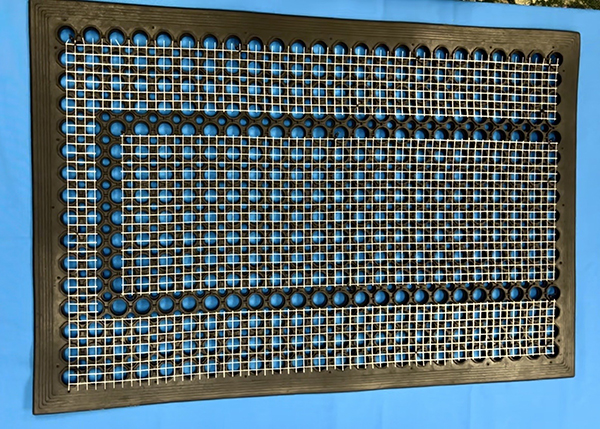
- Using wire cutters and starting about one third of the way up the side of the hardware cloth, cut out a strip that is about three squares wide. When your cut gets near the other end, don't cut all the way through the cloth, leave about 2 inches and turn your cut up at a right angle. When you get about two thirds of the way up the mat, turn your cut again. You should end up with a large C-shaped panel on the outer part of the mat and a smaller straight panel inside. These will be the two poles in the electrical circuit. Be sure to secure new borders with zip ties.
- The finished mat can now be set by connecting the positive or hot lead clamp to the C-shaped panel, and the ground lead clamp to the straight panel. When turned on, test the voltage by touching the tester's ground probe to the ground panel and the testing probe to the hot panel. There should be a reading of at least 6,000 volts.
- When set up as a positive/negative mat, a bear must touch both panels to complete the circuit. A shock will occur if a paw touches positive and negative together or if one paw is on positive and the other on negative.
The following covers three different ways to configure an electric unwelcome mat depending on the surface the mat will be resting on and where the bear will be standing when it touches the mat:
Positive/negative configuration without ground rod: The hot lead connects to the C-shaped panel; the ground lead connects to the straight/smaller rectangular panel. There is no grounding rod required because this mat configuration may be set on a deck, driveway, or other surface that is not very conductive. Use this configuration if you do not expect a bear to be standing on a well-grounded surface. The bear must touch both panels to be shocked.
Positive/negative configuration with ground rod: Connect the hot lead to the C-shaped panel and the ground lead to a ground rod. Run an insulated electric fencing wire to connect the ground rod to the straight ground mat panel.Use this configuration when a bear may be on a variable surface or approach from different directions, like the intersection of a driveway, stone walkway, and grass. This provides good shock from all potential contact points.
All-hot configuration: The hot lead connects to the metal panel and the ground lead connects to a grounding rod. Connect both panels together to act as one hot surface using a short piece of insulated fencing wire or fence connector. Use this configuration if a bear is going to be standing on good earth, such as grass, where the circuit can be completed back to the grounding rod.
Be sure to test your mat regularly to ensure it is configured properly.
For safety, place warning signs nearby so people know the mat is energized. You can step across a mat with rubber-soled shoes.
Content last updated on October 05, 2026.