

Bureau of Special Education Update, January 2026
In This Issue
From the Director’s Desk

Welcome 2026! As we begin a new year, we do so with a renewed sense of purpose and shared responsibility for supporting students with disabilities across Connecticut. This moment offers an opportunity not only to look ahead, but also to reaffirm our collective commitment to equity, access, and improved outcomes for students and families.
The start of the year is an especially active time for districts and partners, as planning, budgeting, and implementation efforts converge. Within the Bureau of Special Education, our focus remains on strengthening systems that support high-quality identification, inclusive practices, and meaningful educational experiences for students with disabilities. This edition of our newsletter highlights Commissioner Russell-Tucker's release of the Independent Review Report, an important milestone that provides both affirmation of CSDE's current efforts and actionable recommendations to further strengthen special education statewide. In parallel, Connecticut's submission of the IDEA Part B State Performance Plan/Annual Performance Report underscores our continued commitment to accountability, transparency, and continuous improvement in outcomes for students with disabilities.
We are currently planning professional learning opportunities for parents and educators for the following school year and beyond, refining guidance and resources to support Planning and Placement Teams and preparing to roll out new grant opportunities initiatives in the months ahead.
We are grateful for the continued engagement of stakeholders across the state. Your feedback, collaboration, and willingness to share perspectives are essential to ensuring that our work is responsive, practical, and grounded in the realities of schools and communities. This partnership is particularly critical as we finalize updated resources and plan future supports that reflect both state priorities and local needs.
In the coming months, you will see opportunities focused on strengthening inclusive programming, supporting students with IEPs who have experienced trauma, and enhancing collaboration across districts and regional partners. We are excited about the potential of this work and the positive impact it can have on students, families, and educators.
It is an honor to serve alongside you in this important work. As always, the Bureau of Special Education remains committed to providing timely information, meaningful resources, and ongoing support. We hope you find the contents of this newsletter helpful as you navigate the busy months ahead, and we thank you for your continued leadership, dedication, and partnership on behalf of Connecticut's students with disabilities.In partnership,

Bryan Klimkiewicz
Division Director, Bureau of Special Education
Connecticut State Department of Education

Bureau Updates
Commissioner Russell-Tucker Releases Independent Review to Strengthen Connecticut's Special Education Systems
On Wednesday, January 14, Commissioner Russell-Tucker released the independent special education systems review conducted by WestEd, reaffirming the Connecticut State Department of Education's commitment to transparency, accountability, and continuous improvement in services for students with disabilities. The final WestEd Review is organized into four core areas of recommendation:
- Leading with Vision: The review emphasizes the importance of clearly articulating and consistently communicating the Department's vision for students with disabilities, aligned with the State Board of Education's Five-Year Comprehensive Plan. Strengthening shared understanding of priorities and strategic direction is critical to advancing coherence across initiatives and supporting sustained progress.
- Improving Infrastructure: WestEd identified opportunities to better align staffing roles and responsibilities, streamline internal processes, and improve the usability of the Connecticut Special Education Data System. These recommendations are intended to increase efficiency, reduce bottlenecks, and ensure that systems better support educators, districts, and families.
- Activating Strategies for Instructional Impact: The report highlights persistent workforce shortages in special education and related services and calls for stronger coordination between the Bureau of Special Education and the Department's Talent Office. It also underscores the need for high-quality, accessible professional learning to build capacity across the field.
- Ensuring Effective Accountability and Improvement: The review identifies dispute resolution and state complaint processes as areas requiring attention. WestEd recommends strengthening legal oversight, improving timeliness and consistency, and ensuring that complaint and due process systems remain legally sound, transparent, and responsive.

General Supervision
Connecticut's Part B State Performance Plan/Annual Performance Report Submission
Each year, the CSDE submits the Part B Special Education State Performance Plan (SPP) Annual Performance Report (APR) to the U.S. Department of Education's Office of Special Education Programs (OSEP) by February 1st (or the first weekday in February). This comprehensive report measures Connecticut's performance across 18 indicators covering critical areas of special education services, including educational environments, outcomes on statewide assessments, graduation rates, dropout rates, early childhood outcomes, parent involvement, dispute resolution, timely evaluation and IEP implementation, post-school outcomes, and disproportionality in identification of students with disabilities and discipline rates of students with disabilities including by race/ethnicity. The APR reflects data from the previous school year and demonstrates compliance as well as results-based targets established with stakeholder input in our six-year State Performance Plan.
Following the February submission, OSEP reviews Connecticut's APR and typically provides feedback and clarifying questions in April. The state then has an opportunity to respond and update the information in the APR during a brief clarification period. This allows Connecticut to address OSEP's questions, provide additional context, and make any necessary corrections to the initial submission. In June, following the clarification period, OSEP conducts its final review and issues a determination of whether a state has met the requirements under IDEA Part B. OSEP also identifies strengths in the state's general supervision system as well as identifies any compliance concerns. This annual reporting cycle is essential for ensuring accountability, maintaining federal funding, and driving continuous improvement in special education services for all Connecticut students with disabilities. The data collected through this process helps inform state-level policies, technical assistance priorities, and resource allocation to better serve our students and families.
Below is a timeline for the current (FFY 2024 – '24-'25 data) Part B APR submission:
- Submission Due Date – February 2, 2026
- Clarification Period Opens – April 9, 2026
- Clarification Period Closes – April 23, 2026
- State Determinations Finalized – June 18, 20206

Legislative Updates / Fiscal Matters
Special Education Expansion and Development Grant Subrecipient -Grant Application Launch - Due 2/20/26
Public Act 25-67 (Sec. 7) entitles each school board to a new special education expansion and development (SEED) grant. The SEED grant funds can only be used for special education purposes as defined in the legislation. For information on the SEED Grant, please review Special Education Fiscal RFPs and Grants.
On January 22nd, the CSDE loaded the SEED Grant subrecipient application (SA), in the electronic grant management system (eGMS). School Districts are currently completing their applications which are due on or before Friday, February 20, 2026, at 4:00 pm.
Applicants are required to complete a Project Details Page outlining goals and activities and a corresponding Budget that directly aligns with the proposal. Continued updates will be provided at the conclusion of the application process.
Public Act 25-93, Section 25, An Act Increasing Resources For Students, Schools And Special Education
For the fiscal year ending June 30, 2027, and each fiscal year thereafter, the Department of Education shall administer the special education training, education and testing competitive grant program. There has been $500,000 allocated to this grant beginning July 1, 2026, through June 30, 2027. The Talent Office and Bureau of Special Education have been providing updates and receiving input from a variety of partners including but not limited to the LEA Advisory Group and the Paraeducator Advisory Council. The CSDE is considering a variety of options to execute this grant in alignment with the legislative requirements.

Input / Feedback
Statewide Professional Learning and Technical Assistance
Under the IDEA general supervision requirements, state education agencies have a responsibility to provide technical assistance and training to ensure that schools and educators have the knowledge and tools necessary to implement IDEA requirements correctly and deliver appropriate services to students with disabilities. Additionally, the state is required to offer ongoing professional development and training opportunities to build capacity and support continuous improvement across the system. To that end, annually, the CSDE partners with SERC and the RESC Alliance and other partnerships to ensure that a comprehensive network of professional learning and technical assistance opportunities are available to professionals working with students with disabilities at all levels of the educational system.
The CSDE is well underway with planning statewide training and professional learning with our partner agencies for the 2026-27 school year. If you have specific training needs for the upcoming school year, please let us know by contacting Nikki Hendry at hendry@ctserc.org.
New Special Education Leaders Program Request for Input
The New Special Education Leaders program is focused on supporting special education leaders during their first and second years in their positions. This program reflects a collaborative partnership between the Bureau of Special Education (BSE) and the University Center for the Excellence in Developmental Disabilities (UCEDD). Many of the presenters are consultants from the BSE who provide new leaders with the opportunity to have their questions answered, as well as provide them with up-to-date information and resources.
As we seek to provide new special education leaders with the support and information they need, we ask that you take less than 5 minutes of your time to answer a brief survey; this will assist with our planning for future sessions.
Complete the New Special Education Leader Survey.
State Advisory Council for Special Education Vacancies- Special Education Teacher and Paraeducator
If you have an interested special education teacher and/or a paraeducator in your district who would be interested in serving on the State Advisory Council for Special Education (SAC), please contact Catherine Summ (Catherine.Summ@ct.gov) and Brian Smith (Brian.K.Smith@ct.gov) via email.
For more information, visit the CT State Advisory Council for Special Education.
Policy and Guidance Reminders
New Prior Written Notice (PWN) Resources
In July 2022, Connecticut's Prior Written Notice (PWN) document was substantially revised from the previous notice used in the state and embedded in CT-SEDS.
The Bureau of Special Education (BSE), as part of our General Supervision responsibilities conducts annual desk audits of IEPs and the quality of PWN documents issued in the state. As a result of information gathered through this process, as well as requests from special education leaders, the BSE has developed four example PWN documents to support district personnel's understanding of the type of information that is appropriate to be included in PWN.
It is important to note that the provided examples do not cover every situation PWN is required, however the examples include the following scenarios:
- Evaluation Proposal
- Identification Proposal
- Provision of FAPE Proposal
- Change of Placement Refusal
The BSE encourages district leaders to review the PWN examples with their staff to help ensure that the notices being issued by the district contain information necessary for parents to understand why the related action is being proposed or refused.
These examples were shared with local special education leaders and will be posted on the BSE website in the near future.

Abilities in Action
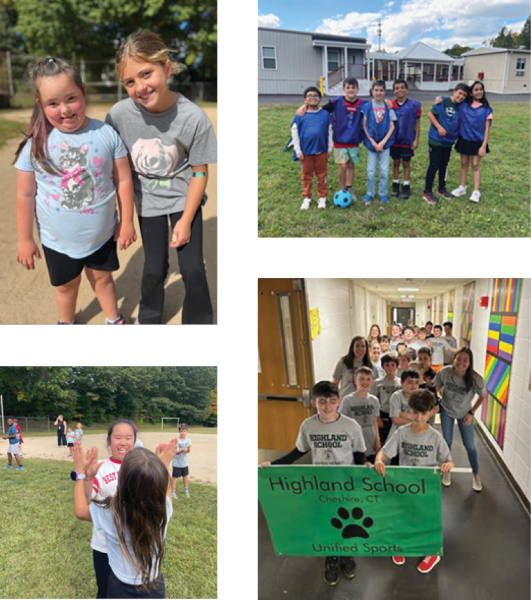
Special Olympics Spirit of Inclusion Award – Highland Elementary School, Cheshire
Each year, Special Olympics Connecticut celebrates schools and programs that make a difference from across the state at its annual Hall of Fame dinner, honoring individuals and programs that promote inclusion and belonging. Through this program, school-based Unified initiatives are recognized for their meaningful efforts to create inclusive school communities. We are proud to share that Highland Elementary School has been selected as one of only three distinguished schools to receive this honor for its outstanding commitment to Unified activities and inclusive practices.
Your district/program could be featured in the next issue! Inspire others by submitting your success stories or achievements! We look forward to hearing from you!
Fill out the Abilities in Action Submission Form
Training and Professional Development Highlights
IDEA Grant Part B Grant Section 611/619 – FY27 Subrecipient Application (SA) Training
The session will focus on a review of the FY27 SA requirements and timelines, a summary of changes from last year's application, and an examination of the LEA Maintenance of Effort (MOE) and expenditure timeline.
Special Education Directors, Administrators, IDEA Grant Managers, Business Managers, and local education agency (LEA) staff who contribute to the IDEA Part B SA Grant or who have access to the eGMS are encouraged to attend this session.
- February 20
- Virtual 9 am-11 am or 1 pm-3 pm
- View the State Education Resource Center Events calendar for more information and registration
Secondary Transition Coordinator Training--Winter/Spring Registration Open!
We are excited to announce the winter/spring dates for the training for Secondary Transition Coordinators, developed by the CSDE in collaboration with DDS, ADS, and the RESCs pursuant to Conn. Gen. Stat. § 10-74q.
This full-day, in-person session provides a comprehensive overview of secondary transition planning through the role of the Secondary Transition Coordinator. Participants will examine professional responsibilities, including legal requirements, best practices, and strategies for supporting students with disabilities. The session highlights essential transition resources, services, and public programs offering transition-only services to enhance planning and family engagement. Completion fulfills state mandated training requirements and strengthens participants' ability to support successful post-school outcomes.
There are six scheduled sessions, running from January through May 2026. These sessions are offered at no cost to transition coordinators. Please note that if you have previously attended this training, you do not need to attend again.
Enrollment Guidelines:
Sessions will open to both primary and secondary transition coordinators. The timeline for completion of this training, outlined in Conn. Gen. Stat. § 10-74r, is the following:
- If appointed before May 1, 2025, training must be completed within three years.
- If appointed after May 1, 2025, training must be completed within one year.
Register for Secondary Transition Coordinator Training.
A Step-by-Step Approach for Inclusive Schools – Multi-Day
Step by Step for Inclusive Schools is a systems-wide model for improving the quality and amount of time students spend in inclusive settings. Implemented across ten states and adopted on a statewide basis in Florida and Connecticut, Step by Step training results in meaningful change at the district, school and classroom levels benefiting all students and the school community.
This two-day team training in Step by Step emphasizes the importance of individualized student-centered decisions for assigning supports and services. In the training, each participating school will create an action plan and identify criteria for determining successful implementation of effective practices. This action plan addresses six critical themes: 1) Instructional Settings 2) Collaboration and Shared Responsibility for Supporting Students 3) Instructional Excellence for Diverse Learners 4) In-Class Support Models and Strategies 5) Peer and Family Relationships 6) Effective Use of Personnel.
As a result of this training, participating teams will learn: a clear definition of inclusive education; instructional strategies to meet the needs of diverse learners in the general education classroom; three distinct staffing models to assure that students and teachers receive the support they need; a process for scheduling that makes the best use of resources, and many more practical strategies; five strategies to improve the quality and impact of paraeducator services, and; an effective peer assistance and peer tutoring program.
Participants must register as a team, to include the required team members: Principal, GE teacher, Special Ed teacher, Related Service Provider(s).
Teams may also include: Paraeducator and family member.
- Wednesday, February 11, 2026, 9 am – 3 pm
- Wednesday, March 25, 2026, 9 am – 3 pm
- Location: West Hartford Conference Center
- 50 South Main Street
- West Hartford, CT 06107

CT-SEDS Training Highlights
All Winter and Spring IEP and CT-SEDS Sessions now live
Download the updated training flyer for all new session descriptions and registration links.
Office of Dyslexia and Reading Disabilities Updates
In January, as we celebrate a New Year, we encourage educators, families, community partners, and students to connect with the ODRD and share something new they have learned about dyslexia through the Connecticut Dyslexia Awareness Collaborative.
Voluntary Family Reading History Questionnaire
Pursuant to Connecticut General Statutes (C.G.S.) Section (Sec.) 10-14ee, the Connecticut State Department of Education (CSDE) has approved the abbreviated Adult Reading History Questionnaire (ARHQ-brief) as the required voluntary family history questionnaire to assist districts in the identification of students in grades Kindergarten through third (K–3) who are at risk for reading proficiency challenges. In the document you will find the following:
- Letter to Charter School Directors and Superintendents
- The Voluntary Family Reading History Questionnaire
- Sample Letter to Families
- Voluntary Family Reading History Questionnaire Question-by-Question Guide
- Voluntary Family Reading History Questionnaire: Frequently Asked Questions
- The Sample Letter to Families and Questionnaire are also available in Spanish and Portuguese.
Learn about the Voluntary Family Reading History Questionnaire.
ODRD Upcoming Events
Language and Literacy Acquisition for English Learners and Multilingual Learners
- Tuesday, February 3, 2026
- 6:00–7:00 p.m.
- Register for the Language and Literacy Acquisition for English Learners and Multilingual Learners session.
Understanding, Supporting, and Empowering Dyslexic Children
- Wednesday, February 25, 2026
- 6:30–7:30 p.m.
- Register for the Understanding, Supporting, and Empowering Dyslexic Children session.
Read Across America with Carmen Agra Deedy
- Friday, March 6, 2026
- 1:00–2:00 p.m.
- Register for the Read Across America with Carmen Agra Deedy session.
Connecticut Reading Association Conference
- March 11, 2026
- View Connecticut Reading Association 2026 Conference details.
ODRD Resources
- Check out our monthly newsletter - The Monthly Decode.
- Check out our podcasts.
- If you weren't able to attend November or January's sessions focused on Using Assessment Data to Develop Present Levels of Performance and IEP Goals and Objectives, view recordings of the webinars.

Resources
CSEES: Job Candidate Numbers Strong in December
As you continue to recruit highlight qualified special teachers, related service providers, paraeducators, and support personnel, the CSDE wanted to remind you of The Connecticut Special Education Employment System (CSEES). CSEES is a FREE platform for districts to recruit qualified candidates for special education jobs. The CSEES system just saw its strongest December ever, with 299 job placements. There were 128 districts using the system in December if you are not one of them, please consider posting your vacancies on this site. The platform point of contact Dale, is also available to discuss specific marketing strategies for your district. For technical assistance, visit CSEES - Connecticut Special Education Employment System.
Connecticut Youth Leadership Forum (YLF)
Applications are now open for the Connecticut Youth Leadership Project, Inc. (CT-YLP) - 27th Annual CT Youth Leadership Forum (YLF), scheduled for July 27 – July 30, 2026, at the University of Connecticut, Storrs campus. Attached you will find the CT-YLP Memorandum and 2026 CT YLF Student Application (deadline: February 20, 2026). Submit a CT-YLP Student Application.
The CT-YLP has requested that copies of this application be made available to any current sophomore, junior, or student in a transition program (with at least one year remaining after the forum) with a disability.
Questions can be directed to Stephanie Barksdale, Executive Director, by phone at 860-689-6868 or by email at execdir@ctylp.org.
Want to Learn How to Support Deafblind Students?
The programs below are designed to address the critical need for highly qualified professionals prepared to support Deafblind learners across educational and community-based settings. Each option integrates discipline-specific preparation with specialized coursework in Deafblindness, emphasizing communication access, sensory learning, interdisciplinary collaboration, and family-centered practice.
These programs are well suited for educators, Teachers of the Deaf, Teachers of the Visually Impaired, related service providers, and professionals seeking advanced preparation to serve children and youth with deafblindness and complex learning needs.
Option 1
- What? Master of Education (EdM) in Deaf Education + Graduate Certificate in Deafblindness
- Where? Boston University, in-person, with full-time and part-time options
- When? Application due date: August 1, 2026
- Contact: Todd Czubek by email at taczubek@bu.edu
Option 2
- What? Master of Education (MEd) in Vision Studies: Teacher of the Visually Impaired + Graduate Certificate in Deafblindness
- Where? University of Massachusetts Boston, online and part-time
- When? Application due date: February 15, 2026
- Contact: Tammy Reisman by email at Tammy.Reisman@umb.edu
Option 3
- What? Master of Education (MEd) in Vision Studies, Assistive Technology for Visual Impairment + Graduate Certificate in Deafblindness
- Where? University of Massachusetts Boston, online and part-time
- When? Application due date: June 15, 2026
- Contact: Rachael Sessler Trinkowsky by email at R.SesslerTrinkowsky@umb.edu
What are the benefits of these degree & certificate options?
- Grant funding to help cover the cost of your tuition
- All-expenses-paid interdisciplinary activities in Boston to promote collaboration across the programs
- Preparation in a highly sought after field from 2 nationally recognized universities
Interested in the Graduate Certificate in Deafblindness on its own?
Contact Callie Brusegaard: Callie.Brusegaard@umb.edu
Upcoming Events
LEARN disABILITY Summit
We are excited to welcome families, caregivers, educators, and community members to the 6th Annual LEARN disABILITY Summit! This important region wide event will be held on Saturday, March 14, 2026 from 10:00 am - 3:00 pm at the Great Wolf Lodge Conference Center in Mashantucket, CT.
This free, family-friendly event brings together individuals and organizations dedicated to supporting individuals with disabilities from birth to age 21. Attendees can explore a wide range of exhibitors, connect with local service providers, and gather helpful resources.
Last year's Summit featured 60+ exhibitors, 10 community partners, and welcomed over 500 attendees from across the region. The event offers a meaningful opportunity to learn, connection, and celebrate inclusion in action.
Admission and parking is free, and all are welcome! We invite you to join us for a day of learning, collaboration, and community.
For questions, please email us at disabilitysummit@learn.k12.ct.us. Please note, this mailbox is only monitored during business hours and it may take up to 48 hours to receive a response.
Attend the Disability Summit via LEARN Student Support Services.