

Bureau of Special Education Update, September 2025
In This Issue
From the Director’s Desk
September 2025 Newsletter Update from Bryan Klimkiewicz, Division Director, Bureau of Special Education

It’s hard to believe that September is nearly behind us and the 2025–26 school year is already in full swing. We hope the year has started smoothly for you, your students, and your school communities. Much like our school districts, the work of the Bureau of Special Education continues year-round and around the clock, and with the start of this new school year, we are energized by the possibilities ahead for every student we serve.
As you review this month’s updates, I encourage you to pause and reflect on the bigger picture your work supports. The policies, training opportunities, and resources represent another step toward schools where all students feel a sense of belonging, and are valued, supported, and empowered to succeed.
It is an honor to represent the Bureau of Special Education as we work collaboratively to provide information, resources, and supports to educators and families with the goal of improving outcomes for students with disabilities. We thank you for your partnership in this work!
In partnership

Bryan Klimkiewicz
Division Director, Bureau of Special Education
Connecticut State Department of Education
 Bureau Updates
Legislative Updates
Public Act 25-67 § 7
The recent legislative session brought a major financial commitment to special education in Connecticut. Through Public Act 25-67, Section 7, the General Assembly established the Special Education and Expansion Development (SEED) Grant, providing $30 million in direct funding to school districts. Allocations will follow the distribution methodology outlined in section 10-262f of the general statutes, also known as the Education Cost Sharing (ECS) statute. Districts have already been notified of their award amounts, and the CSDE is developing guidance, along with an application and evaluation process, to support effective implementation of this grant.
Public Act 25-67 § 1 (Developmental Delay eligibility expanded to age 8)
Previously, in CT Planning and Placement Teams could identify students as eligible for special education and related services under the primary disability category of Developmental Delay between the ages of three and five. Effective July 1, 2025, Public Act 25-67 § 1 expands the allowable age for this primary disability category to age eight. The extended Developmental Delay age does not preclude PPT’s from identifying a student as eligible under any of the other 14 primary disability categories in CT.
How is Developmental Delay Defined in Connecticut?
Developmental delay means “significant delay in one or more of the following areas:
- physical development;
- communication development;
- cognitive development;
- social or emotional development; or
- adaptive development, as measured by appropriate diagnostic instruments and procedures and demonstrated by scores obtained on an appropriate norm-referenced standardized diagnostic instrument.”
School districts should be aligning their policies and practices to accommodate the disability category and definition for "developmental delay" along with the recommended criterion.
Public Act (PA) 25-67 § 13 – New mandate prior to placing a student in an out of district placement due to challenging behaviors
Effective July 1, 2025, PA 25-67 § 13 mandates that on and after September 1, 2025, prior to placing any student in an out of district placement due to challenging behaviors, each local and regional board of education must conduct a Functional Behavior Assessment (FBA) and develop or update a Behavior Intervention Plan (BIP). An FBA and a BIP shall not be required if the time required to conduct such assessment or develop or update such plan would put the safety of such student, any other student or any staff at such student's school at risk.
The CSDE posted guidance on this new requirement on the CSDE website: Legislative Update Public Act (PA) 25-67 – Mandate prior to placing a student in an out of district placement due to challenging behaviors .
Listing of Public Transition Programs (PTPs)
Pursuant to Conn. Gen. Stat. § 10-74n, there must be an easily accessible and navigable online listing of public transition programs (PTPs). This listing is available on EdSight, under the following path: General - School/Districts - Transition Programs. Each district’s program information is maintained by its LEA Directory Certifier. To find the Directory Certifier for your district, visit EdSight - Find Contacts, and filter the role to “LEA Directory Certifier”.
Each year, the CSDE/BSE will request that all LEAs complete the PTP Informational Form for every PTP operated by the district. In addition, LEAs are required to annually distribute a notice of the online listings to the parent(s) of a student receiving special education and related services in grades 6 to 12. This notice must be provided to the parent(s) during a Planning and Placement Team (PPT) meeting. The information can also be found in the Transition Bill of Rights for Parents of Students Receiving Special Education Services.
 Feedback / Input Needed
WestEd Survey
Connecticut Commissioner of Education Charlene M Russell-Tucker has engaged WestEd to conduct a comprehensive evaluation of the Connecticut State Department of Education’s (CSDE) special education infrastructure, processes, and accountability and support systems. The goal of this evaluation is to strengthen CSDE’s special education system, so it is responsive, effective, and provides high quality, timely support and services to improve outcomes for all students with disabilities.
As part of this work, the WestEd team is conducting a survey to gather feedback from individuals across the state. The insights gathered will be used to inform actionable recommendations to strengthen current policies, structures, and practices within the Bureau of Special Education and CSDE more broadly.
We invite you to share your perspective on how the Connecticut State Department of Education can improve special education services in the state. The survey is anonymous, is available in English and Spanish, and should take you no more than 5-10 minutes to complete. Thank you for considering this opportunity to contribute to this important work! We look forward to hearing from you.
 Policy and Guidance Reminders
English Learners/Multilingual Learners (EL/ML)
As a reminder, the Connecticut State Board of Education (SBE) has published the Parent Bill of Rights for English Learners and Multilingual Learners on the CSDE website in 37 languages spoken by the 54,000 ELs/MLs and their families statewide.
Like any student, an EL/ML may be a student who has special education needs. If a student is dually identified as being an EL/ML and has an individualized education program (IEP), the student is entitled to receive a language instruction education program for the EL/ML needs and special education services identified through an IEP. EL/ML services and special education services are on an equal footing and neither trumps the other. In the case of a dually identified student, the language needs should be represented by a TESOL/bilingual teacher or language instruction provider in the planning and placement team (PPT) process.
Pursuant to the Individuals with Disabilities Education Act (IDEA) school districts have an affirmative, and ongoing, duty to locate, identify, and evaluate all children with disabilities residing within their school districts who are in need of special education and related services, in a timely manner. This “child find” obligation applies equally to EL/ML students. Policies that delay initial special education evaluations of EL/ML students based on their EL/ML status, the amount of EL services they are receiving, or their responses to intervention are impermissible under the IDEA.
When conducting initial evaluations and evaluations in accordance with IDEA requirements, school districts must ensure that the assessments and other evaluation materials used to assess the child:
(1) Are selected and administered so as not to be discriminatory on a racial orcultural basis; and
(2) are provided and administered in the child's native language or other mode of communication and in the form most likely to yield accurate information on what the child knows and can do academically, developmentally, and functionally, unless it is clearly not feasible to so provide or administer.
These requirements aim to ensure that EL/ML students are determined eligible for special education and related services based on their disabilities, and not because of their limited English language proficiency.
If an EL/ML student is found eligible for special education and related services, the school district must provide the student with a free appropriate public education (FAPE) under the IDEA, while also fulfilling its language assistance obligations under other applicable federal laws.
If an EL/ML student is a child with a disability under the IDEA, the PPT is responsible for developing an IEP, which delineates the special education and related services necessary to provide FAPE for the student. When developing the IEP, the PPT is required to consider the language needs of a child with limited English proficiency as those needs relate to the student’s IEP.
“Out of State Student Transfers” and “Lapsed IEPs”-Updated/Revised Guidance
Resources can be found within the CSDE tab in CT-SEDS.
- SWD Enrolls from Out of State 5-30-2025
- CT SEDS Student Enrolls with a Lapsed IEP Rev. 5-30.

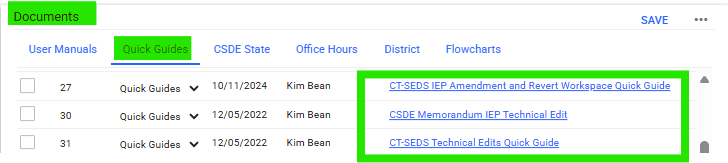
Understanding IEP Amendments vs. Technical Edits
When an IEP Amendment is Necessary
Changes to Legally Required IEP Components
- If a correction or modification is needed in any of the mandatory sections of the IEP (as defined by IDEA and Connecticut state law), an amendment must be completed.
- Present levels of academic achievement and functional performance
- Measurable annual goals and short-term objectives
- Special education and related services (including frequency, duration, and location)
- Accommodation/modifications for assessments
- Participation in general education settings (LRE statement)
- Transition services (for students 14+)
- Transfer of rights at age of majority
- PWN is not a part of the IEP and corrections do not require an IEP amendment. If a PWN contains an error (e.g., wrong date, incorrect service description) The district can issue a corrected PWN with a note stating it replaces the prior version (e.g., "This notice supersedes the PWN dated [original date].")
When a Technical Edit is Sufficient (No Amendment Needed)
- Minor clerical errors in supplementary (non-mandatory) sections of the IEP, such as:
- Misspellings, incorrect dates, or transposed numbers
- Checkbox errors (e.g., incorrect disability category marked)
- Updates to non-educational data (e.g., school name, case manager, grade level)
- The district must notify parents of the correction and provide an updated copy
District Staff should reference resources provided in the CT-SEDS Document Widget under the Quick Guides Tab:
 Early Childhood Special Education
Indicator 7 (Early Childhood Outcomes): Transition from Brigance IED-III to CT DOTS for ECO Data Collection
The Connecticut State Department of Education (CSDE) is transitioning from the Brigance IED-III to the Connecticut Documentation and Observation for Teaching System (CT DOTS) for reporting Early Childhood Outcomes under Indicator 7 of the State Performance Plan/Annual Performance Report (SPP/APR). This shift is informed by the following key considerations:
- Alignment with Standards: CT DOTS is directly aligned with the Connecticut Early Learning and Development Standards (CT ELDS).
- Developmentally Informed Approach: CT DOTS supports observation of developmental trajectories and integrated skill growth across domains.
- Collaborative Framework: CT DOTS engages all team members, including families, in tracking a child’s development across various contexts.
- Use of Multiple Evidence Sources: Teams can document functional skills and behaviors using diverse, authentic sources across settings and situations.
This change is intended to support more holistic, developmentally appropriate, and inclusive assessment practices.
For the 2025–2026 school year, CSDE will offer a range of professional learning opportunities—available in-person, asynchronously, and virtually—to support districts in preparing for the statewide adoption of CT DOTS for ECO reporting in 2026–2027. Training topics will include:
- Introduction to CT Early Learning Development Standards (CT ELDS) for Special Education & Related Service Providers
- CT Documentation and Observation for Teaching System (CT DOTS) for Special Education & Related Service Providers
- Connecting Practice to Purpose: Using Standards and Assessment in the Development and Progress Monitoring of the Preschool IEP
- Nuts and Bolts: Using CT DOTS for Early Childhood Outcomes (ECO) Data Collection Training details and registration will be shared throughout the year via the RESC Alliance website.
Updates will also be communicated directly to special education directors and early childhood special education supervisors. For further information, please contact: Renee Kleinman Early Childhood Special Education Consultant (Part B/619) Email: renee.kleinman@ct.gov.
CT Early Childhood Special Education Resource Padlet
This Padlet was created as a resource for Early Childhood Special Education administrators, teachers and related service providers. The Padlet contains links to frequently used documents and resources. This Padlet will be updated with new information and topics throughout the course of the year. Topics you can currently find on the Padlet include:
- CT DOTS
- CT ELDS
- Contact Information for B23 and School Districts
- CT-SEDS Documents
- Early Childhood Outcomes (ECO)
- Early Intervention Services Over Age 3
- OSEP Resources
- Professional Development Opportunities
- Sparkler
- Transition from Part C to Part B
- Transition to Kindergarten
Connecticut Pyramid Model Monthly Newsletter
The Parent Infant and Early Childhood Team (PIEC) Team within the Innovations Institute at the University of Connecticut School of Social Work, in partnership with the Connecticut Pyramid Model Partnership (State Leadership Team), is pleased to return to your inbox with a monthly Pyramid Model newsletter. In the newsletter you will be able to find resources for your classroom and work with children & families, as well as information about Pyramid Model activities and accomplishments in our state, invitations to trainings, and other support options for educators, providers, and families, and much more.
Early Childhood Special Education Professional Development Opportunities
Smooth and Effective Transitions: Building Bridges from Early Intervention to Preschool Special Education
Join the CT State Department of Education (CSDE), CT Birth to Three (B23) and the CT Parent Advocacy Center (CPAC) for an in-person session designed for:
- Part C Early Intervention administrators and providers
- Part B/619 Early Childhood Special Education administrators and educators
- Families and early childhood providers interested in learning more about the transition process
What to Expect
- Federal and State Requirements – Gain clarity on timelines, procedures, and compliance expectations.
- Collaboration & Networking – Connect with colleagues across your region, share effective practices, and explore valuable resources.
- Interactive Q&A – Ask questions and problem-solve with peers and experts.
Session Details
- Length: 3 hours, in-person
- EdAdvance September 30, 2025, 9:00-12:00
- CES October 17, 2025, 9:00-12:00
- ACES October 24, 2025, 9:00-12:00
- LEARN November 7, 2025, 9:00-12:00
- CREC November 10, 2025, 9:00-12:00
- EASTCONN November 14, 2025, 11:00-2:00
Who Should Attend
Early intervention administrators and providers, early childhood special education administrators and educators, families, and other early childhood professionals. It is highly suggested that each Birth to Three program and school district appoint at least one representative who can attend the session in your region to relay information back.
Why Attend?
Together, we can ensure smooth, supportive, and successful transitions for young children moving from Part C Early Intervention to Part B Preschool Special Education. Don’t miss this opportunity to build connections, strengthen practices, and support children and families during this important transition.
Preschool Special Education (Part B/619) Forum
This virtual forum, designed for early childhood special education administrators, supervisors and program coordinators, will include four one-hour sessions held between September 2025 and June 2026. Each session will feature a presentation on a pre-selected topic followed by a roundtable discussion. Participants are encouraged to bring questions for peer feedback and idea sharing, as well as to exchange relevant resources. A pre-forum survey will be distributed to help guide the selection of discussion topics for the year.
Please Note: It is strongly recommended that if an early childhood special education administrator or coordinator is unable to attend, each LEA appoint a representative from their district who can join to ask questions on their behalf and relay the information back.
Each session will meet from 1:00-2:00 on:
- September 25, 2025
- December 11, 2025
- March 26, 2026
- May 14, 2026
Part C (Early Intervention Services) and Part B (Preschool Special Education) Lunch and Learn
This virtual Lunch and Learn series is designed to be a collaborative learning opportunity for both Part C and Part B directors, administrators, program coordinators and providers/educators to come together to support early childhood transition. The first half of the session will focus on a topic and/or any updates from the CT Office of Early Childhood (OEC) Part C Director, Nicole Cossette and the CT State Department of Education (CSDE) Early Childhood Special Education/Part B 619 Consultant, Renee Kleinman followed by a roundtable discussion. Providers can bring questions to these sessions related to early childhood transition and pose them to their colleagues for support, insight and ideas.
Each session will meet from 12:00-1:00 on:
- December 3, 2025
- February 11, 2026
- April 30, 2026
Please check the SERC website for registration for both of these opportunities and additional information.
Early Childhood Special Education Large City Forum
These virtual sessions are being brought back by popular demand. These sessions will allow administrators, supervisors, and program coordinators from larger school districts the opportunity to provide support and guidance to each other around early childhood special education (Part B/619).
In the past the following districts have participated in these sessions: Glastonbury, Manchester, Bristol, New Haven, Hamden, Stratford, Wallingford, Southington, Stamford. Waterbury, Enfield, Hartford, Bridgeport, East Haven, East Hartford, Meriden, New Britain, Danbury, Waterbury, West Haven, Milford, Norwalk.
These sessions will take place virtually on:
- October 23, 2025 1:00-2:00
- January 15, 2026 2:00-3:00
- February 26, 2026 1:00-2:00
- April 22, 2026 1:00-2:00
- June 11, 2026 1:00-2:00
Please email Renee Kleinman, Early Childhood Special Education Consultant/Part B 619, at renee.kleinman@ct.gov if you are interested in participating this year.
Participation is not limited to the districts listed above. If your district has not participated in the past and you would like to participate, please email Renee.
For all interested participants, in the subject line of the email please put RE: ECSE Large City Forum – Name of District. A registration link will be provided upon receipt of interest.
 Abilities in Action
Highlighting Thompson, CT Mary R. Fisher Elementary School’s Language Based Classroom
Thompson, CT is proud to highlight the transformative work being done in Mary R. Fisher Elementary School`s Language Based Classroom, a K-3 program designed to support students with dyslexia and language-based learning difficulties. This inclusive model combines targeted intervention with general education, ensuring all students thrive academically and emotionally.
Key Features:
- Expert Instruction- co-teachers trained in structured literacy and Orton-Gillingham- certified staff deliver explicit, multisensory lessons through small-group, whole group and 1:1 instruction.
- Inclusive by Design- classrooms are thoughtfully composed of 50% students with language-based disabilities and 50% typical peers. Typical peers are selected based on strong academic and social-emotional skills.
- Proven Success- Data shows remarkable gains in reading accuracy, fluency, and comprehension with some students achieving 98% post-intervention.
- Holistic Focus- The program emphasizes morphology, etymology, and executive functioning skills, benefiting all learners.
Thompsons commitment to equity and innovation shines through this program, proving that with the right support, every child can excel.
Highlighting Sterling Community School’s Traci Jamieson, (BCBA)
Sterling Community School has dedicated the past ten years to developing systems that support and enhance student learning and behavior. During this time, Traci Jamieson, a Board-Certified Behavior Analyst (BCBA), has worked closely with administrators, mental health professionals, and teachers to develop and implement tiered behavior supports for Pre-K to 8th-grade.
Traci's collaboration with the Tier 1 team has led to the establishment of universal supports for all students. This team has created school-wide expectations and a plan to reinforce appropriate behaviors. Additionally, they have developed flowcharts to prevent and respond to challenging behaviors. The team meets twice a month to review data, celebrate successes, and identify and address areas of concern.
At Sterling, bi-weekly behavior data team meetings are held, where Traci works with grade-level teams to focus on individual students who may need additional support. By employing a function-based problem-solving approach, the team collaborates to address and meet the needs of students. Traci conducts Functional Behavior Assessments and develops and assists in the implementation of Behavior Intervention Plans for students requiring more intensive support.
To ensure consistency and continuity, Traci provides training at the beginning of each school year on the behavior support system at Sterling for all new staff. She is also available to assist staff with classroom management and evidence-based strategies aimed at increasing engagement and reducing problematic behaviors.
Sterling Community School takes great pride in its efforts to meet the needs of all students, ensuring their success in the classroom.
 Training & Professional Development Highlights
ParaSharp by 321 Insight: Free Professional Learning for Paraeducators
321 Insight and the CSDE are excited to continue partnering to offer bite-sized, job-specific professional learning for paraeducators, to help them better address challenging behavior and be more effective with students. These resources are available to all Connecticut paraeducators at no cost to your district/program throughout the 2025-2026 school year.
ParaSharp by 321 Insight is a flexible resource that can be used to meet the needs of your staff through the Build Your Own pathways, the Guided PD Pathways, or the brand-new ParaSharp Applications.
The Build Your Own Pathway allows you to create and assign your own customized pathways that best support your educators’ learning needs.
The Guided PD Pathways are curated pathways, organized around targeted learning objectives, provide brief videos, resources, self-assessments, and best practice strategies to help educators support all students. The Guided PD Pathways is designed to help you provide 18+ hours of PD to your educators.
ParaSharp Applications is designed to provide educators with new learning, and authentic opportunities to apply what they learn, in their practice supporting students. Intended for educators who have experience with the ParaSharp series, ParaSharp Applications includes 5 - 13-minute videos and supporting resources to build an even deeper understanding of the challenges educators face every day. Culminating Go Do It! applications provide targeted strategies educators can implement with students and record the outcomes and impact.
For more information about the partnership, new features, and next steps for getting started, please complete the Google form to sign up for a 30-minute informational session with 321 Insight.
Secondary Transition Coordinator Training
We are excited to announce the Fall 2025 dates for the full-day, in-person Secondary Transition Coordinator Training! Registration is now open for six sessions, scheduled between October and December, with one held at each RESC.
The timeline for completion of this training, outlined in Conn. Gen. Stat. § 10-74r, is the following:
- If appointed before May 1, 2025, training must be completed within three years.
- If appointed after May 1, 2025, training must be completed within one year.
Please contact Alexa Osterhout, alexa.osterhout@ct.gov, if you have any questions.
IEP Quality and CT-SEDS Proficiency Training
New professional learning opportunities for Fall 2025 are still live for registration. Sessions include: Core- 12 hour IEP Quality, Discipline Specific Goal Development (newly integrated with Standards Alignment), IEP Quality for School Leadership Teams, CT-SEDS Onboarding and a variety of CT-SEDS Targeted Sessions: IEP Quality & CT-SEDS Proficiency Training Registration.
The RESCs also offer In-District Training. Make an In-District Training request.
| Session Name | Date | Time | Description | Register |
|---|---|---|---|---|
| CT-SEDS Onboarding | , , | – | 3-part virtual series focused on CT-SEDS User Proficiency Training. Designed for newly certified special educators or those new to CT-SEDS. | Register on Protraxx |
| IEP Quality for PreK — Core 12-Hour Series | , , , , , , , | – AM | Multi-session, 12-hour course to strengthen preschool educators' capacity to create and implement high-quality IEPs. Includes live demonstrations of CT-SEDS functionality. Not a CT-SEDS Proficiency Training. | Register on Protraxx |
| Goal Development for PreK | & | – PM | Interactive training for preschool educators (must have attended the CORE) to develop high-quality, measurable IEP goals and objectives. | Register on Protraxx |
 CT-SEDS Highlights
District and School Calendars
Reminder to set up School and District: School Year, Day, ESY, and Progress Reporting Calendars. Resource can be found in Quick Guides tab of the Documents Widget "School & District Calendar Quick Guide 2024".
CT-SEDS Office Hours for 2025-2026 School Year
Dates for Office Hours Sessions School Year 2025-2026:
- September 30, 2025 @ 2:00 *New Date
- November 18, 2025 @ 2:00
- February 25, 2026 @ 2:00
- April 28, 2026 @ 2:00
The 2024-2025 School Year Office Hours PowerPoint and Documents are posted on the CT-SEDS Documents Widget under the Office Hours tab.

CT-SEDS Help Desk
The CT-SEDS Help Desk actively responds to support tickets submitted. Districts should follow their internal structures for support and accessing the CT-SEDS Help Desk.
 Resources
 The Bureau of Special Education’s 22nd Annual Back to School Meeting: Progress Through Partnerships
Thank you to all who attended The Bureau of Special Education’s Back to School Meeting! If you were unable to attend, please click below to access resources provided to attendees.
Resources | The Bureau of Special Education’s 22nd Annual Back to School Meeting
Lead IDEA
 Lead IDEA is a national technical assistance center that provides support and training for IDEA Leadership. Their website contains research-based information related to Strengthening Services for Students with Disabilities, Empowering Belonging, Enhancing Collaboration between General and Special Educators, Leadership Essentials, and Special Education Retention.
 Upcoming Events
Office of Dyslexia and Reading Disabilities Update: Statewide Dyslexia Awareness Collaborative Kickoff!
When: Tuesday, October 7, 2025 | 5:30-8:00 PM
Location: UConn Main Building - Waterbury campus 99 East Main Street Waterbury, CT 06702:
Presenters: Deon L. Butler, former NFL Athlete, Motivational Speaker, and Author and Dr. Fumiko Hoeft, Physician and Neuroscientist, Campus Dean and CAO of UCONN Waterbury
Featuring inspiring talks and meet-and-greets, giveaways, and more.
This event is open to the public, including legislators, teachers, administrators, parents, and students.