

Bureau of Special Education Update, December 2025
In This Issue
From the Director’s Desk

As 2025 draws to a close we are reminded that the work of supporting children and youth with disabilities continues with care, purpose, and commitment. This time of year offers a meaningful opportunity to reflect on the collective efforts of educators, families, and leaders whose dedication strengthens systems and improves outcomes for students across Connecticut.
Even as we pause to mark the season, the work ahead is already taking shape. It is hard to believe that planning is underway for 2026–27 professional learning opportunities for parents and educators. We look forward to continuing this work alongside you and to supporting your evolving needs as you strive to improve outcomes for students with disabilities. We also recognize that many of you are deep in budget season, and we encourage you to reach out to the Bureau of Special Education with ideas and suggestions for how the CSDE can best support your mission.
We are especially grateful to the many stakeholders who took the time to provide thoughtful feedback on the updated draft Autism Eligibility Worksheet, designed to support Planning and Placement Teams in determining both initial and continued eligibility for students. With more than 100 individual responses received, we are carefully reviewing and considering this input to strengthen the document prior to its release.
Looking ahead, the new year will bring competitive grant opportunities to support students with IEPs who have experienced trauma, as well as opportunities to enhance and expand inclusive programming within districts or through regional partnerships. We are excited about the potential of these initiatives and the ways they can further support students, families, and school communities.
It is an honor to represent the Bureau of Special Education as we work in partnership to provide information, resources, and supports for educators and families, all with the shared goal of improving outcomes for students with disabilities. We hope you find the information in this newsletter helpful as we close out the year and move into the holiday season. As you navigate this busy time, please accept our sincere appreciation for your leadership, collaboration, and steadfast commitment. We wish you moments of rest, reflection, and renewal in the weeks ahead, and extend our warmest wishes for a happy holiday season and a healthy, successful New Year. Thank you for your continued partnership in this important work.
In partnership,

Bryan Klimkiewicz
Division Director, Bureau of Special Education
Connecticut State Department of Education

Bureau Updates
The Connecticut State Department of Education is Accepting Applications for Surrogate Parents
The Connecticut State Department of Education (CSDE) has opened the application period for qualified individuals to serve as a Surrogate Parent during the 2026-2027 contract year (July 1, 2026-June 30, 2027). Preferred qualifications and minimum experience requirements are outlined in the Request for Applications.
Interested individuals should refer to the Request for Applications posted to: 2025 Request for Application
Completed application packages may be emailed to Surrogate.Application@ct.gov no later than 5:00 p.m. on January 30, 2026. The screening process will be completed within two months of the application deadline, and applicants will be notified by email if they are selected for an interview.
Additional resources and information about the Surrogate Parent Program, including the procedures manual, can be found on the Surrogate Parent Program website. If you have questions, please email us at surrogate.application@ct.gov.
Please note: If you are currently working as an educator, it is not feasible to serve simultaneously as a surrogate parent. If you applied previously, a new application and current supporting documents are required.
General Supervision
As a condition of receiving Individuals with Disabilities Education Act (IDEA) funds, the state education agency (SEA) under IDEA Part B Sections 611 and 619 must have a general supervision system (See graphic below for 8 components of general monitoring and supervision). This system includes multiple components including integrated monitoring to — (1) improve educational results and functional outcomes for infants and toddlers with disabilities and their families, and children with disabilities; and (2) ensure that local education agencies (LEAs) meet the requirements under IDEA, 20 U.S.C. §§ 1412(a)(11), 1416(a), 1435(a)(10) and 1442; 34 C.F.R. §§ 300.149, 300.600–300.604, 300.608, 303.120, and 303.700–303.708.
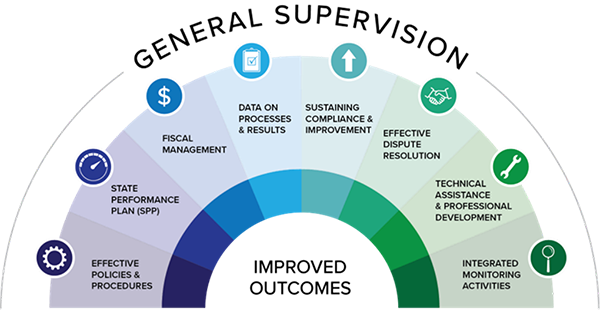
The CSDE continues to implement integrated general supervision and monitoring activities during the current school year, including annual desk audits of IEPs and Prior Written Notice (PWN) documents with approximately one-third of districts statewide. In alignment with Public Act 23-137, unannounced on-site visits are conducted in a subset of these districts and include service verification, classroom observations, staff interviews, and parent interviews. Districts receive a summary report of findings following each on-site visit.
Desk audit results demonstrate increasing fidelity in aligning IEP goals with grade-level standards and clearly linking present levels of performance, annual goals, and services to support meaningful student progress. Opportunities for improvement remain in the quality of PWN documentation, particularly in clearly and specifically communicating actions taken and the rationale for those actions. In response, the CSDE plans to expand existing PWN resources, which districts have identified as useful.
Service verification findings generally confirm implementation of services in accordance with IEPs; however, staffing vacancies continue to impact service delivery. The CSDE has issued Staffing Shortages Guidance Document and remains engaged in statewide recruitment and retention efforts.
Classroom observations and interviews indicate that educators largely have the resources needed to implement IEPs, though time constraints remain a challenge. Districts reporting designated staff to facilitate PPTs and review IEPs note increased efficiency, supported in part by improvements to CTSEDS. Parent communication practices are consistent across districts and aligned with family preferences.
The CSDE will continue to engage in integrated monitoring and supervision activities to support local education agencies in strengthening special education programming and improving outcomes for students with disabilities.

Legislative Updates
Legislative Update Public Act (PA) 25-67 § 2 – Prevents Charging Entity from Increasing Charges After the Start of the School Year
As previously communicated in Series 2025-26: Circular Letter: C1, effective July 1, 2025, PA 25-67 § 2 mandates that a “charging entity” shall not increase the amount charged to a local or regional board of education for a service provided pursuant to an individualized education program (IEP) for a student during said school year, except a charging entity may increase or lower the total amount charged to such board if the charging entity adds or decreases the services provided pursuant to a change in such student's IEP. Read the full legislative update memorandum for detailed requirements,including a charging entity’s request to the Connecticut State Department of Education (CSDE) of the need to increase the amount charged to a local or regional board of education that is not the result of an identified student need as determined by the planning and placement team. Questions related to this new requirement can be directed to Bryan Klimkiewicz at Bryan.Klimkiewcz@ct.gov and Jessica Brunetti at Jessica.Brunetti@ct.gov.
Legislative Update Public Act (PA) 25-93 § 22 – Required Written Notification for Staffing Changes
As previously communicated in Series 2025-26: Circular Letter: C1, effective July 1, 2025, PA 25-93 § 22 mandates that each regional educational service center and private provider of special education services, shall send written notification to the parent or legal guardian of a student receiving special education services, the responsible local or regional board of education, and the Connecticut State Department of Education (CSDE) regarding all staffing changes that impact the provision of special education services not later than five business days from the occurrence of the staffing change. Read the full legislative update memorandum for detailed requirements, including a mechanism for regional educational service centers and private providers of special education services to provide written notification to the CSDE. Questions related to this new requirement can be directed to Bryan Klimkiewicz at Bryan.Klimkiewcz@ct.gov.

Fiscal Matters
IDEA Part B Grant Management for Subgrantees/Subrecipient (LEAs)
Below you will find some important guidance about the management of IDEA Part B grant funds.
- LEAs must ensure the good practice of first in/first out (FIFO), meaning that “old money” (funds from the oldest grant) is expended/liquidated before accessing “new money” (funds from the newest grant).
- LEAs should spend approximately 85% in the grant Award Year (year one); LEAs should not spread the funding out equally over the Period of Performance.
- LEAs must expend all Set Aside funds (i.e., private school activities (02) and CEIS activities (03) funds) in the grant Award Year (year one). LEAs with remaining set aside fund balances after the award year (year one) will be reflected in the CSDE Fiscal Risk Rubric.
- LEAs must expend their entire grant funds (down to $0.00) by the final Period of Performance. LEAs with remaining balances after the grant ends will be reflected in the CSDE Fiscal Risk Rubric.
IDEA Part B funding does not automatically flow to the LEA. Administrative staff and business officials must complete appropriate funding requests, expenditure and end of year reports, and any budget/application revision requests in the electronic grant management system (eGMS) while abiding by the timeline and information below. NOTE: Fund requests cannot be approved until the grant application is in “CSDE Grant Contact Approved” status.
FY25 IDEA Part B Section 611/619 – 7/1/24 to 6/30/26 – “Second Year/Tidings Period"
- Budget/application revisions for the first year (award year) must be completed by 5/1/25.
- All set-aside funds must be obligated or expended by 6/30/25.
- Budget/application revisions for the second year (tydings period) must be completed by 2/1/26.
- All funds must be obligated or expended by the final Period of Performance date (6/30/26*).
- All obligated funds must be liquidated within 60 days of the grant end date (8/30/26).
FY26 IDEA Part B Section 611/619 – 7/1/25 to 6/30/27 – “First Year/Award Year”
- Budget/application revisions for the first year (award year) must be completed by 5/1/26.
- All set-aside funds must be obligated or expended by 6/30/26.
- Budget/application revisions for the second year (tydings period) must be completed by 2/1/27.
- All funds must be obligated or expended by the final Period of Performance date (6/30/27*).
- All obligated funds must be liquidated within 60 days of the grant end date (8/30/27).
Please address any fiscal matters regarding the IDEA Part B Grant Section 611 to Alycia M. Trakas by phone at 860-713-6932 or by email at Alycia.Trakas@ct.gov.
Please address any fiscal matters regarding the IDEA Part B Grant Section 619 to Renee Kleinman by phone at 860-713-6468 or by email at Renee.Kleinman@ct.gov.

Policy and Guidance Reminders
Alternate Assessment System Participation Reminders
Teams should be aware of the CSDE recommended timelines for ensuring accurate rostering of students for summative assessments.
Completed Alternate Assessment Eligibility form in a finalized and implemented IEP:
- December 22, 2025, for CAAELP (students identified as EL/ML in Grades K-12); and CTAA and CTAS (Grade 11)
- February 2, 2026, for the CTAA (Grades 3-8, and newly identified students in Grade 11); and CTAS (Grades 5, 8, and newly identified students in Grade 11)
Early Stopping Rule and Student Response Check and Domain Exemption Window:
The Early Stopping Rule and Student Response Check and Domain Exemption Window will open in TIDE December 1, 2025. District Administrators in TIDE, Special Education Directors, ELACs and TEAs should review the Connecticut Alternate Assessment System Early Stopping Rule and Student Response Check and CAAELP Domain Exemptions for additional information on deadlines, policies and procedures for accurate submission.
Required Online Training for Teachers Administering the Alternate Assessments:
Teachers administering any alternate assessment must have a TIDE TEA user role assigned by their District Administrator (DA for Testing in TIDE). The required online training must be completed annually. It is highly recommended that all online training for the CTAA, CTAS, and if applicable CAAELP be completed by the end of December, although training will remain open through the end of the school year. Once training is completed, TEAs will have the ability to administer the Connecticut Alternate Assessments, have access to related assessment systems that support test administration, and enter CTAS results into the Data Entry Interface (DEI) upon completion of testing.
Available Now! Online Training for Teachers Administering the Alternate Assessments (CTAA and CTAS)
The required, online Connecticut Alternate Assessment System Training is now available on the Connecticut Comprehensive Assessment Program Portal for teachers who have the primary responsibility for assessing students in Grades 3–8 and 11 on the Connecticut Alternate Assessment System. These include:
- Connecticut Alternate Assessments (CTAA) for math and ELA (Grades 3–8 and 11)
- Connecticut Alternate Science (CTAS) Assessment (Grades 5, 8, and 11)
- Supplemental materials to support districts are available on the Alternate Assessment System webpage and in the Student Assessment Newsletter.
- CAAELP Required Online Training for Teachers Administering the Alternate Assessments
Please note, CAAELP trainings are through the ELPA21 site. ELPA21 provides self-paced training modules for individuals assigned to administer the CAAELP assessment, also known as Alt ELPA. These modules are updated annually, and educators administering the CAAELP are required to take this training each school year. TEAs will select the Alt ELPA Summative Assessment Training (SY 2025–26) training module. ELACs, DAs, and Special Education Directors have an optional Alt ELPA Summative: Test Coordinator Training (SY 2025-26) available to them. For more information and resources on CAAELP training please visit the CAAELP Resources page.
Please direct questions to the Performance Office: Deirdre Ducharme at 860-713-6859; deirdre.ducharme@ct.gov or Katie Seifert at 860-713-6722; katherine.seifert@ct.gov.

Early Childhood Special Education
Early Childhood Special Education Professional Learning Opportunities
The CT State Department of Education (CSDE) is preparing for the statewide transition to CT DOTS as the Early Childhood Outcomes (ECO) data collection tool beginning in the 2026–2027 school year. To support early childhood special education teachers, related service providers, and administrators in building familiarity and confidence with the CT Early Learning and Development Standards (CT ELDS) and the CT Documentation and Observation for Teaching System (CT DOTS), a series of virtual professional learning opportunities are being offered. Whether you are new to these tools or looking to strengthen your practice, these sessions are designed to deepen your understanding, provide practical strategies to begin to prepare you for implementation of CT DOTS for ECO data collection.
Introduction to CT Early Learning and Development Standards (CT ELDS)
90-minute virtual session. In this introductory session, participants will:
- Increase their knowledge of the CT ELDS
- Explore key features and how they support preschool students with disabilities
- Engage in hands-on experiences and discussion to apply the CT ELDS in practice
- Who should attend: Early childhood special education teachers and related service providers who are new to CT ELDS or want a refresher.
Introduction to CT Documentation and Observation for Teaching System (CT DOTS)
90-minute virtual session In this session, participants will:
- Learn key features of CT DOTS and how it supports documentation and observation
- Explore practical applications for working with young children with disabilities
- Engage in interactive experiences to build comfort and skill with the tool
- Who should attend: Early childhood special education teachers and related service providers who are new to CT DOTS or want a refresher.
Connecting Practice to Purpose: Using CT ELDS and CT DOTS to Inform Standards-Aligned IEPs
Two 90-minute virtual sessions These sessions invite early childhood evaluators, special education teachers, related service providers, and administrators to:
- Explore how CT ELDS and CT DOTS strengthen the IEP process
- Engage in collaborative activities and statewide networking
- Reflect on how these tools support meaningful, developmentally appropriate goals
- Why attend: Building familiarity with CT ELDS and CT DOTS into your current practice, will make the transition to using CT DOTS for ECO data collection in 2026–2027 smoother and more effective.
Sign up for any of the training opportunities
Please Note: In late spring, implementing CT DOTS for ECO training sessions will be offered in person at each of the RESCs and virtually. More information will be shared soon.

Abilities in Action
ACES NEST (Nurturing Early Support and Transition)
This fall, Shelton Public Schools and Area Cooperative Educational Services (ACES) launched ACES NEST (Nurturing Early Support and Transition) a regional, intensive program designed to support young children with autism and related disabilities. Housed at Perry Hill School, the program delivers highly individualized, evidence-based instruction grounded in Applied Behavior Analysis (ABA).
With a strong emphasis on early intervention, ACES NEST offers a collaborative, language-rich environment supported by a multidisciplinary team, including a full-time BCBA, speech-language pathologist, special education teacher, and 1:1 Registered Behavior Technicians. The program is structured to accelerate student progress during these critical years, with the goal of preparing children for successful transitions or other appropriate placements.
By combining regional resources and expertise, ACES NEST represents a forward-thinking model for delivering intensive early childhood special education services within a public-school setting.
For more Information visit: About Us - ACES.
Empowering Student Voice: SEYAC Panel Enhances PPT Leadership Institute
The PPT Leadership Institute (PPTLI) is designed to equip PPT chairs with tools to foster family and community engagement, as well as improve student outcomes by facilitating team meetings that meet legal requirements, support positive school/parent partnerships, and result in high quality special education programming. Within this process, student voice is seen as a valuable and important component.
Six students who are involved in the Special Education Youth Advisory Council (SEYAC) had the opportunity to participate in a panel discussion with participants from the PPTLI. Through this panel, students did an amazing job sharing their insights and experiences with special education services, their understanding of IEPs, participation in the PPT process and provided suggestions to improve special education services, as well as education overall.
The SEYAC is designed to increase student involvement in the special education process and to help students develop strong, effective leadership skills in order to make positive changes in their school and community.
Visit the SEYAC web page for more information.
Your district/program could be featured in the next issue! Inspire others by submitting your success stories or achievements! We look forward to hearing from you!
Fill out the Abilities in Action Submission Form
Resources
Transition Assessment Resource Manual
We’re excited to announce the launch of our new Transition Assessment Resource Website a centralized hub designed to support educators, transition coordinators, and related service providers in identifying and selecting high-quality transition assessments.
The website features a comprehensive manual that outlines the purpose, use, and selection of transition assessments across key domains such as Employment, Postsecondary Education/Training, Independent Living, and more. Whether you're new to transition planning or looking to enhance your current practices, this resource is designed to guide and support your work.
Explore the manual, discover curated tools, and find the information you need to make informed decisions that support student success.
NEW! View the Connecticut Transition Assessment Resource Manual.
Assistive Technology Services and Resources Available
Assistive Technology Services and Resources available to you!
The State Department of Education (SDE) Bureau of Special Education will continue making an impact on the service provision and support of assistive technology (AT) within school districts across Connecticut.
NEAT Center has extended its work through a direct AT service model and membership to your school district at no cost for the 2025-2026 school year. The NEAT Center is offering the following benefits to you, your teachers, and students effective immediately:
Each school district will be allocated a credit of $2,000 to be used toward any Assistive Technology (AT) or Augmentative and Alternative Communication (AAC) service. This credit is intended to support a range of services, including but not limited to evaluations, training, consultations, and professional development.
Credits must be used by February 1. Any unused funds after this date will be reallocated to other school districts.
Each school district will have access to a NEAT Membership that is inclusive of unlimited access to the AT Lending Library, Webinars, and unique resources and special events.
Sign Up to learn more.
To contact NEAT, please reach out to CentersConnect@oakhillct.org.
Connecticut Youth Leadership Forum (YLF)
Applications are now open for the Connecticut Youth Leadership Project, Inc. (CT-YLP) - 27th Annual CT Youth Leadership Forum (YLF), scheduled for July 27 – July 30, 2026, at the University of Connecticut, Storrs campus. Attached you will find the CT-YLP Memorandum and 2026 CT YLF Student Application (deadline: February 20, 2026). The application is also available on the CT-YLP Student Applications webpage.
The CT-YLP has requested that copies of this application be made available to any current sophomore, junior, or student in a transition program (with at least one year remaining after the forum) with a disability.
Questions can be directed to Stephanie Barksdale, Executive Director, by phone at 860-689-6868 or by email at execdir@ctylp.org.

Professional Development Opportunities
Restorative Practices: Repairing Harm and Building Community
Restorative practices, a field of study examining how to strengthen relationships and improve social connections, have been proven to positively impact student behavior and school climate while uncovering the root causes of conflict. The practices are used to create spaces to facilitate complex conversations to minimize harm, repair relationships, and identify solutions.
Join us for a transformative two-day, in-person journey into Restorative Practices, where you'll deeply explore the foundational principles of this framework through a culturally relevant and responsive lens. Discover how these practices can be seamlessly integrated into your existing MTSS structure to foster a strong sense of community across classrooms, schools, and districts. Deepen your understanding and leave equipped with tools to build inclusive, supportive learning environments.
The first session, session A, is set for January 21 and 22, 2026 with a snow date scheduled for January 29, 2026. Session B will take place March 10 and 11, 2026, and the snow date would be March 12, 2026. All sessions will run between 9 a.m. and 4 p.m., with an hour set aside for participants to have lunch on their own. The cost is $150 and includes two books as well as morning and afternoon refreshments.
Visit https://25-75-107.eventbrite.com to register for session A, or https://26-75-108.eventbrite.com for session B. For registration questions, please contact Heather Dawes, SERC, (860) 632-1485, ext. 263 or dawes@ctserc.org.
Multi‐Tiered Systems of Support for Behavior
Multi-Tiered Systems of Support (MTSS) is a framework for implementing a continuum of academic and social-emotional and behavioral supports meeting students’ needs and enhancing opportunities for achievement while reducing exclusionary school discipline practices that have a disproportionately adverse effect on students with disabilities, students of color and low-income students. During this multi-day training, participants will explore the core tier 1 features necessary to establish an effective, efficient system for school-wide behavior support.
- Day 1: Thursday, December 18, 9 a.m. - 3 p.m.
- Day 2: Wednesday, January 14, 2026, 9am – 3pm
- Day 3: Wednesday, February 4, 2026, 9am – 3pm
- Location: West Hartford Conference Center, 50 South Main Street, West Hartford, CT
- Target audience: School-wide team required to check with presenters for more information.
- Register for Multi‐Tiered Systems of Support for Behavior

Office of Dyslexia and Reading Disabilities Updates
The Monthly Decode Newsletter
Check out The Monthly Decode, CT-Dyslexia Awareness Collaborative's newsletter.
During the month of November, the Office of Dyslexia and Reading Disabilities (ODRD) celebrated gratitude for every educator, student, parent, and community partner championing literacy equity across Connecticut.
Who’s Made a Difference in Your Dyslexia Journey?
Let’s celebrate the individuals making a difference in the lives of students with dyslexia — and keep the momentum going into December!
Has an educator, family member, fellow student, or community partner made a positive impact on your dyslexia journey?
Give them a shout-out! Send your message in whatever format works best for you — video, email, images, or more — to sde.Dyslexia@ct.gov.

CT-SEDS Highlights
IEP Quality & CT-SEDS Professional Support
The Connecticut State Department of Education, in collaboration with the RESC Alliance and State Education Resource Center (SERC), invites you to join a variety of professional learning opportunities to support the development of high-quality Individualized Education Programs (IEPs) and navigation of the Connecticut Special Education Data System (CT-SEDS).
Registration is open for Winter and Spring offerings, including a NEW training offering: Special Education Procedural Foundations.
New Functionality
Procedural Safeguards, Laws Relating to Seclusions and Restraints, Parent Guide to Special Education in CT, and Transition Bill of Rights documents are now available in CT-SEDS for translation in the top 10 languages in CT. If the student Document Language is set on the Student Information Page, these documents can be generated in that language and automatically sent to the Parent Portal upon finalization through Create/View Documents. Building a Bridge document will be configured for translation in the future.
Note: Selecting these documents in the last panel in the IEP Process does not automatically create, translate, batch or send them with the finalized IEP. This is only to confirm which documents were shared with the parent. The district will need to generate the document in Create/View Documents to send directly to parent portal or download/print and share a hard copy with the parent. The IEP Manual is not available for download in Create/View Documents.

Upcoming Events
Save the Date: Inclusive School Safety Practices for Students with Disabilities
Parent Event- April 27, 2026
- 4:30p.m.-7:30p.m.
- Southern Connecticut State University (SCSU) New Haven, CT 06515
Professional Event- April 28, 2026
- 8:30a.m.-4:00p.m.
- Southern Connecticut State University (SCSU) New Haven, CT 06515
For more information, contact schoolsafetycenter@wcsu.edu.