
Executive Summary:
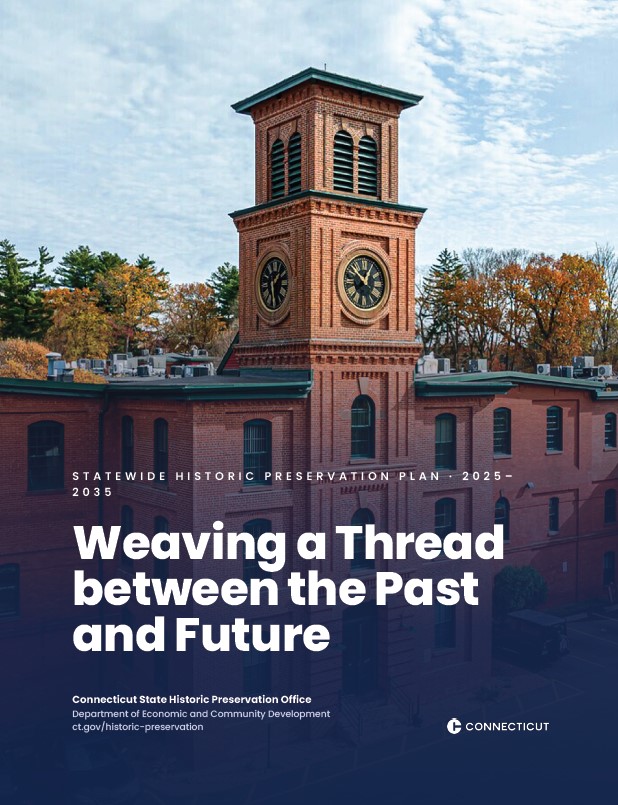
As the state agency responsible for guiding the identification, protection, and revitalization of our state's irreplaceable historic resources, the Connecticut State Historic Preservation Office (SHPO) is happy to present the Connecticut Statewide Historic Preservation Plan 2025–2035: Weaving a Thread between the Past and Future. This updated plan builds off the many accomplishments under the previous plan, Shared Stewardship: 2018–2023 Statewide Historic Preservation Plan, and offers a roadmap for decision-making by public, private, municipal, and nonprofit partners, so they may harness the power of historic places as a catalyst for economic growth, community well-being, and cultural continuity.
Connecticut's historic places are more than markers of our past. They are living assets that anchor our communities, fuel our economy, and sustain our quality of life. Historic preservation is a proven engine for job creation, housing supply, downtown revitalization, and sustainable development. Since creating the State Historic Preservation Office in 1955, Connecticut has woven preservation into its identity by investing in these irreplaceable resources. These investments yield benefits that extend far beyond numbers. Rehabilitated buildings reduce waste, bolster sustainability, expand housing opportunities, and foster walkable, vibrant neighborhoods that strengthen social cohesion and support public health.
Legislative support remains essential. Continued investment in tax credits, grant funding, and collaborative frameworks sustain thousands of jobs, attract millions in private capital, and preserve the character that makes Connecticut unique. By championing historic preservation, our state can ensure that every new chapter honors the rich threads of our shared past.
The National Park Service requires that each state has an approved statewide historic preservation plan in place to participate in the federal historic preservation program and to receive federal funding support for preservation activities. These statewide plans are meant to encourage broad public and professional participation in planning for cultural resources, meet challenges unique to each state, influence historic preservation policy in state and local governments, and inspire local communities, organizations, and individuals to action.
While the SHPO is responsible for facilitating the planning process, writing the plan, and updating it periodically, the concepts, goals, and objectives in the plan are the result of extensive collaboration among many participants. The plan will be most effective if its goals and objectives are championed and implemented by local communities, non-profit organizations, state agencies, and other partners, not just the SHPO.
During Autumn 2024, the CT SHPO led a collaborative effort to develop the plan through broad-based outreach, intended to solicit input from a wide variety of parties involved in decision-making about historic properties. This engagement strategy involved a variety of public and partner meetings and online surveys to engage stakeholders and the public.
Throughout this process, two critical needs were repeatedly identified as the most pressing: additional funding to support historic preservation activities in Connecticut, and the desire for educational and training opportunities.
Five strategic goals were developed with public input:
GOAL1:
Quality of Life
Elevate quality of life by preserving and revitalizing our historic places, ensuring they remain vibrant, accessible, and central to our cultural identity and economic vitality.
GOAL 2:
Education & Appreciation
Inspire appreciation of our state's historic built environment and archaeological resources through engaging educational initiatives that deepen public understanding of why preservation matters.
GOAL 3:
Partnerships
Strengthen partnerships across government agencies, non-profits, educational institutions, community groups, and preservation leaders to collectively safeguard our shared heritage.
GOAL 4:
Power of Data
Harness the power of data to improve how cultural resources are identified, documented, and interpreted to encourage informed and equitable decision making.
GOAL 5:
Adaptability
Promote adaptability in historic preservation practice. Recognize that the physical landscape, natural and built environment, building codes, available materials, and construction technology are dynamic, and allow for innovation in historic preservation solutions, while maintaining the integrity of historic resources.
An important aspect of the process was to ensure that the plan aligned with larger state planning efforts, including the recently adopted Connecticut Conservation and Development Policies Plan 2025–2030. Each of the five priority areas (referred to as Visions in the Conservation and Development plan) aligns closely with the goals and objectives of preservation and can be advanced using the potential of historic properties. These five visions are Economic Vitality, Housing Diversity, Resource Stewardship, Community Health, and Inclusion and Connectivity.
As we move forward into the implementation phase, it is our hope that the same spirit of partnership and collaboration that went into this plan will continue. Everyone in Connecticut is invited to play a role in advancing the goals of this plan and preserving our State's incredible historical legacy. We invite every resident, municipality, and partner to join in safeguarding and activating these treasures for the needs of today and the generations of tomorrow.
By championing historic preservation, our state can ensure that every new chapter honors the rich threads of our shared past.
Click here to view the full Statewide Historic Preservation Plan