


Lake Waubeeka 2025
Lake Waubeeka, Danbury
2025 Aquatic Vegetation Survey
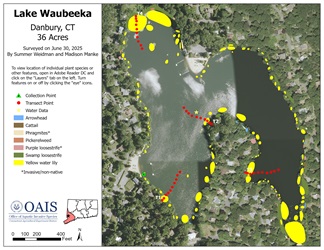
Lake Waubeeka is a private, 36-acre man-made lake located in Danbury, Connecticut, and is managed by the Lake Waubeeka Association (LWA). The lake has a maximum depth of 21 feet and an average depth of approximately 9 feet, with substrates that are often mucky and rich in organic material. Most of the shoreline is developed, and the lake includes two private beaches with designated, roped-off swimming areas. Motorized boats are prohibited; however, non-motorized watercraft, including rowboats, canoes, sailboats, paddle boats, and kayaks, are permitted with a valid registration sticker.
On June 30, 2025, CAES OAIS conducted its fourth aquatic vegetation survey of Lake Waubeeka. The survey documented a total of seven aquatic plant species. Two invasive wetland species, phragmites (Phragmites australis) and purple loosestrife (Lythrum salicaria), were observed in small, scattered patches around the lake. Yellow water lily (Nuphar variegata) was the most abundant species, occurring extensively along the lake perimeter and growing in water depths of up to 6 feet. Swamp loosestrife (Decodon verticillatus) was the second most abundant species and was present along much of the shoreline. Arrowhead (Sagittaria spp.) was found in small patches in the southern half of the lake, while cattail (Typha spp.) occurred in a single patch on the southeastern shoreline. Pickerelweed (Pontederia cordata) was observed in a few small, localized patches throughout the lake.
Aquatic vegetation conditions have remained largely unchanged since the 2022 survey, which documented the same seven species with similar distributions and abundances. Lakes with a diverse plant community are desirable for aquatic organisms, water quality enhancement, and ecosystem stabilization. Lake Waubeeka’s current total of seven species makes it one of Connecticut’s least diverse lakes with grass carp herbivory likely the cause. In 2005, Lake Waubeeka supported extensive and diverse aquatic vegetation across much of the lake. Grass carp were introduced in 2008, and by 2019, aquatic vegetation was largely limited to emergent species and water lilies along the shoreline.
|
Species recorded in the 2025 survey of Lake Waubeeka. |
|||
| Arrowhead | Cattail | Phragmites* | Pickerelweed |
| Purple loosestrife* | Swamp loosestrife | Yellow water lily | |