


Diamond Lake 2025
Diamond Lake, Glastonbury
2025 Aquatic Vegetation Survey
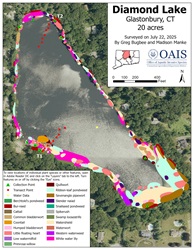
Diamond Lake is a privately owned, 20-acre waterbody located south of Route 94 in eastern Glastonbury, Connecticut. The lake is primarily spring-fed and includes a spillway on the southeast shore that allows for a six-inch water-level drawdown. Maximum depth is approximately 12 feet, and residents report “good” fishing conditions. Shoreline development is sparse to moderate, with most lakefront properties maintaining trees and natural vegetation. Agricultural influences on the lake appear to be minimal.
On July 22, 2025, CAES OAIS conducted its third aquatic vegetation survey of Diamond Lake. A total of 20 native aquatic plant species were documented, and no invasive species were observed. This represents an increase from the nine native species recorded in 2006 and the 16 native species recorded in 2020. Increases in species richness often occur over time when no single species becomes dominant. A lake-level drawdown event prior to 2006, possibly associated with dam repairs, may have contributed to this pattern.
The dominant species in 2025 were white water lily (Nymphaea odorata), watershield (Brasenia schreberi), ribbon-leaf pondweed (Potamogeton epihydrus), and little floating heart (Nymphoides cordata). Western waterweed (Elodea nuttallii), slender naiad (Najas flexilis), and humped bladderwort (Utricularia gibba) were commonly found growing together around the lake perimeter, often in association with seven-angle pipewort (Eriocaulon aquaticum), which was particularly abundant along the southern shoreline. Emergent, wetland species, including bur-reed (Sparganium spp.), cattail (Typha spp.), and swamp loosestrife (Decadon verticillatus), were consistently present along the shoreline in small patches. Additional species observed in one or two localized areas included snailseed pondweed (Potamogeton bicupulatus), primrose-willow (Ludwigia spp.), Berchtold’s pondweed (Potamogeton berchtoldii), waterwort (Elatine spp.), spikerush (Eleocharis spp.), coontail (Ceratophyllum demersum), low watermilfoil (Myriophyllum humile), and quillwort (Isoetes spp.). Because low watermilfoil can be easily confused with invasive variable watermilfoil, specimens collected from Diamond Lake were examined in the laboratory to confirm species identification.
Water clarity (Secchi transparency) decreased slightly from 2.5 meters in 2006 to 2.0 meters in both 2020 and 2025. Given the limited number of sampling events, this change should not be interpreted as a long-term trend. CAES research indicates that water clarity in Connecticut lakes ranges from approximately 0.3 to over 10 meters, with a statewide average of 2.3 meters.
|
Species recorded in the 2025 survey of Diamond Lake. |
|||
| Berchtold's pondweed | Humped bladderwort | Ribbon-leaf pondweed | Swamp loosestrife |
| Bur-reed | Little floating heart | Sevenangle pipewort | Watershield |
| Cattail | Low watermilfoil | Slender naiad | Waterwort |
| Common bladderwort | Primrose-willow | Snailseed pondweed | Western waterweed |
| Coontail | Quillwort | Spikerush | White water lily |