

Spotted Lanternfly
Lycorma delicatula
Spotted Lanternfly in Connecticut
The spotted lanternfly (SLF) is a new pest in Connecticut. It is invasive to the United States. SLF has spread to many states. It was first found in Fairfield County in 2020. As of 2025, SLF has been seen in all counties.
Identify Report Quarantine Resources
What can you do if you see a spotted lanternfly (SLF)?
See the resources below for help. There are ways to control SLF and tree-of-heaven.
You can use this form to report a spotted lanternfly if you'd like. You will need to a picture and your address. Reports without pictures and addresses can't be accepted. You may not receive a response. All reports are confidential.
Connecticut does not have a public program for the control of SLF or tree-of-heaven.
About Spotted Lanternfly
Spotted lanternfly was first seen in Pennsylvania in 2014. It is an invasive insect that is native to Asia. It may affect agriculture in Connecticut. Important plants it may damage are grapes, hops, and ornamental trees. Adult SLFs can feed on more than 70 types of plants. Its preferred host is the tree-of-heaven. Tree-of-heaven is an invasive tree in Connecticut. It can grow in very harsh conditions. You may see it along roads, fields, and parking lots. SLFs are attracted to these trees.
SLF Quarantine in Connecticut
The Connecticut Agricultural Experiment Station (CAES) has issued a Quarantine Order. This defines restricted areas for SLF. Its purpose is to slow the spread of SLF in CT. This order allows businesses to move regulated articles out of state. These are: plants, wood, outdoor containers and vehicles, and more. If you have a business that sells these, you may need a compliance agreement.
To read the public hearing about this order, click here: Public Hearing
The order is effective until December 31, 2025. After then, it may be renewed, rescinded, or replaced.
Below are links to the quarantine order and compliance agreements.
Spotted Lanternfly Quarantine Order
The SLF Compliance Agreement for Nursery and Plant Material
The SLF Compliance Agreement for Non-Plant Material
Resources for SLF
Management/Control Techniques
There are options to slow the spread of SLF, see our factsheets below. Click to open the link.
Spotted Lanternfly Management for Landscape Professionals
Spotted Lanternfly Management for Residents
Written instructions to make a Lampshade Trap to capture egg masses
-Video Demonstration for making a Lampshade Trap
Spotted Lanternfly Management for Vineyards
Spotted Lanternfly Checklist for Homeowners, Moving Companies/Industry
Tree-of-Heaven Information and Management
Tree-of-Heaven Identification Guide
Map of citizen-reported SLF sightings in Connecticut, by town
Check out CAES's SLF press releases by clicking this link: Press Releases
How to identify SLF
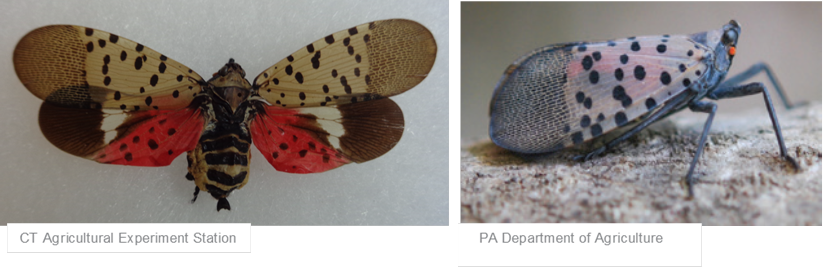
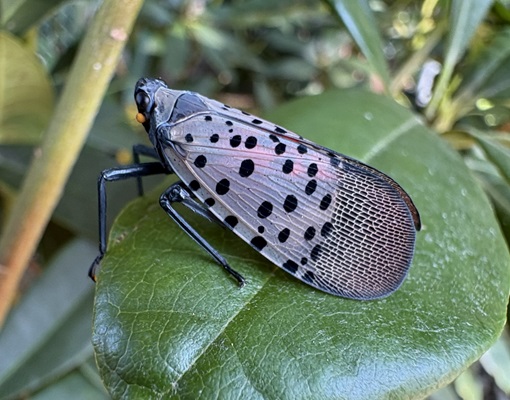
Adult spotted lanternflies are about one inch long and one half inch wide. They have tan forewings that have black spots. Their hindwings have lower red patches and upper black patches, separated with a white section in between. The red hindwings are mostly hidden unless the wings are spread. Adult SLF crawl, jump, or fly short distances. You will see adults from July to November.
|
Fig 1: Side view of adult SLF Raffaela Nastri, CAES |
Fig 2: Top view of SLF adults with wings open and closed Lawrence Barringer, Pennsylvania Department of Agriculture, Bugwood.org |

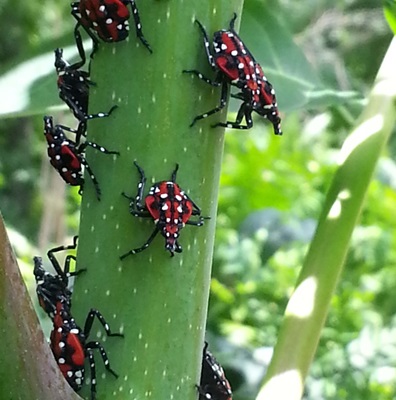
Spotted lanternfly eggs hatch in the spring and early summer. Early instar nymphs are black in color with white spots; fourth instars nymphs are red with black and white spots. You will see nymphs from April to October.
|
Fig 3: Early stage nymph Lawrence Barringer, PDA, Bugwood.org |
Fig 4: Late stage nymph Victoria Smith, CAES |

|
Fig 5: SLF adults and late stage nymphs Richard Gardner, Bugwood.org |
Fig 6: Early and late stage nymphs Victoria Smith, CAES |


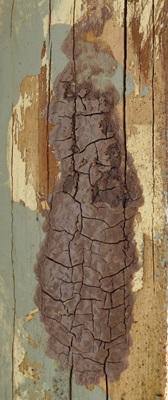
The spotted lanternfly eggs masses are laid on practically any surface including trees, stones, trash cans, side of a house, etc. during the fall. Egg masses are yellowish-brown in color, and most are covered with a gray, waxy coating prior to hatching (USDA, 2019). They may appear wet or sticky when fresh. You will see eggs from September to May.
|
Fig 7: Fresh egg mass Raffaela Nastri, CAES |
Fig 8: Fresh egg mass (uncovered) Raffaela Nastri, CAES
|
Fig 9: Old egg mass Lawrence Barringer, PDA, Bugwood.org |
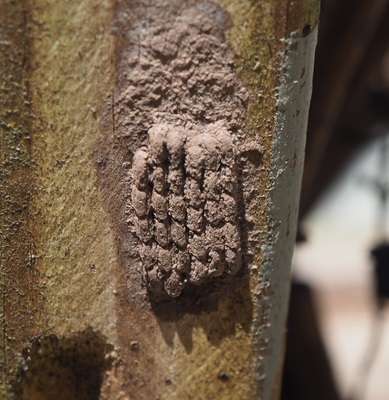

|
Fig 10: SLF adult and egg masses Richard Gardner, Bugwood.org |
Fig 11: SLF egg masses Lawrence Barringer, PDA, Bugwood.org |


Where is SLF found?
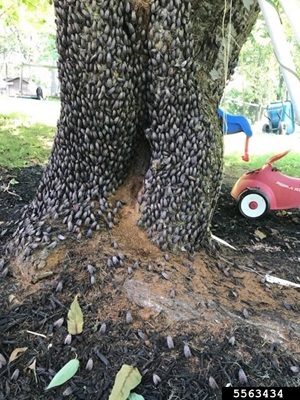
Tree-of-heaven, Ailanthis altissima, is the favored host tree. However, SLF may be found on maple, walnut, and willow trees. It also feeds on apples, grapes, hops, and other fruit trees. In the fall, large groups of adults can be found on tree-of-heaven and other host trees.
To identify Ailanthus altissima: view the tree-of-heaven identification fact sheet
Hitchhiking SLF
Check your vehicles for SLFs! Check your cars and trailers for adult SLFs and egg masses. They may hide on your car when you travel through infested areas. In the fall, they may lay eggs on cars. They have even been seen on clothing!
What Impact Will SLF Have?
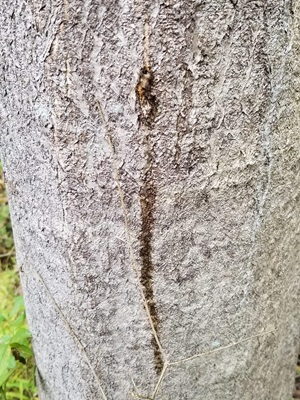
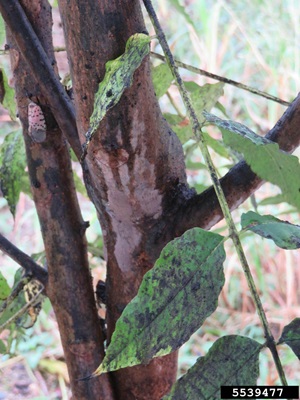
SLF is mainly a nuisance. They can’t bite humans. As nymphs and adults drink sap from plants, the plants can be damaged. While feeding, SLF excretes honeydew. This sticky substance can grow black sooty mold. The mold can block sun from plants. In infested areas, honeydew falling on the ground can be very slippery. Honeydew can also attract bees and wasps. Also, other counties may reject agricultural products if they think they have SLFs.
|
Fig 11: Weeping sap from SLF feeding Gerda Magana, CAES |
Fig 12: SLF feeding damage Emelie Swackhamer, Penn State University, Bugwood.org |
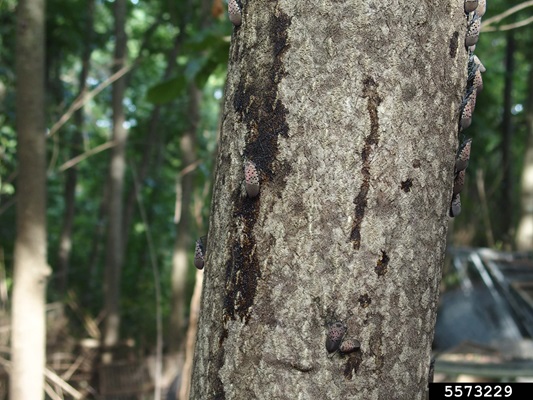
|
Fig. 13: A backyard tree infested with SLF Lawrence Barringer, PDA, Bugwood.org |
Fig. 14 Sooty mold Kenneth R. Law, USDA APHIS PPQ, Bugwood.org |
Podcasts on SLF
In the episode, "CAES Programs, Services, and the Spotted Lanternfly," Dr. Victoria Smith from CAES is interviewed about SLF and the Station. Click this link to watch on YouTube: https://youtu.be/OFvb_sZS8Gw
Videos and Webinars on SLF
Click this link to watch our SLF webinar on YouTube: https://youtu.be/6kT6bxrCWbM
More information about SLF can be found at the following websites:
https://extension.psu.edu/spotted-lanternfly
https://portal.ct.gov/DEEP/Forestry/Forest-Protection/Spotted-Lanternfly
https://www.aphis.usda.gov/aphis/resources/pests-diseases/hungry-pests/slf/spotted-lanternfly
References
Connecticut Department of Energy and Environmental Protection. (2020, September).
CT Spotted Lanternfly. Retrieved October 29, 2020, from
https://portal.ct.gov/DEEP/Forestry/Forest-Protection/Spotted-Lanternfly#trees
USDA, Animal and Plant Health Inspection Service, Plant Protection and Quarantine.
(August 2019). Pest Alert, Spotted Lanternfly (Lycorma delicatula).